



Alcohol detox
Alcohol detox is the medical stage of treatment, and its purpose is to carry a patient safely through withdrawal. We run it as an inpatient programme under medical supervision, with a nurse and a paramedic on site around the clock, at a centre outside Warsaw. It usually takes 3 to 7 nights.
admission usually the same day
What medical detox from alcohol involves
Alcohol detox is a medical process in which the body passes through withdrawal under observation. The symptoms arise because the nervous system has adapted to alcohol being constantly present, and is left in an over-excited state once the level in the blood falls. Medically assisted alcohol detox means monitoring those symptoms, assessing the risk of complications, and treating where treatment is indicated.
Alcohol withdrawal symptoms
Symptoms differ between patients and change over time. Their severity depends on how long and how heavily a person has been drinking, general health, co-existing illness, and the number of previous withdrawals.
Most common
Anxiety and restlessness. Insomnia. Gastrointestinal upset. Nausea and vomiting. Discomfort in the chest.
Also seen
Low mood. Psychomotor agitation. Tremor in the hands. Heavy sweating. Raised blood pressure. Sensitivity to light.
In severe cases
Hallucinations. Delirium. Seizures. These require immediate medical help and cannot be managed at home.
What raises the risk
Weeks of continuous drinking, previous seizures or delirium, liver and pancreatic disease, living alone, and medication that interacts with alcohol.
Urgent medical help is needed if withdrawal produces:
- seizures or loss of consciousness
- severe confusion or signs of psychosis
- aggression out of keeping with the situation
- chest pain or difficulty breathing
- high fever with hallucinations
- suspected overdose
In these situations no one should attempt treatment alone or wait for an admission assessment. Call emergency services immediately on 112, the emergency number in Poland and across the European Union.
Alcohol detox timeline
On the question of how long alcohol detox takes, the answer here is usually 3 to 7 nights. A drip takes a few hours, but detox does not end when alcohol leaves the blood. Symptoms intensify precisely as the level falls, and the most dangerous ones appear on the second and third day, which is when things look better from the outside. That is why even a short detox has to cover those days in full.
Early symptoms
- tremor in the hands and throughout the body
- heavy sweating
- restlessness, irritability, anxiety
- nausea, no appetite
- insomnia
- rapid pulse and rising blood pressure
Symptoms intensify
- marked psychomotor agitation
- visual or auditory hallucinations with consciousness preserved
- vomiting and headache
- rising anxiety
Risk of seizure
- seizures, most often within this window
- electrolyte disturbance
- high fever
- wide swings in blood pressure
Delirium tremens
- disorientation in time and place
- delusions and hallucinations without insight
- severe agitation and aggression
- tachycardia, fever, dehydration
- an immediately life-threatening condition
Alcohol detox cost
We publish the rates, because the question of what detox costs comes up in almost every first call. The price depends on the length of stay and the standard of room.
| Room | Per night | 3 nights | 7 nights |
|---|---|---|---|
| Double | 850 EUR | 2,400 EUR | 4,800 EUR |
| Single | 1,650 EUR | 4,800 EUR | 8,400 EUR |
Three nights in a double room are 2,850 USD and seven nights 5,700 USD. The price covers accommodation, medical supervision, round-the-clock nursing and paramedic cover, medication, infusions, laboratory testing and meals. Higher room standards, longer stays and rates in other currencies are on the pricing page. Therapy after detox is billed separately.
Alcohol detox at home: when it is enough and when it is not
After a short episode, in someone with no previous complications and with another adult in the house, a home visit is usually enough. A doctor examines the patient on the spot, gives an infusion and medication, and then judges whether the condition allows them to stay at home. In Warsaw we offer this as alcohol detox at home.
Inpatient detox is necessary when the drinking has gone on for weeks, when there have been seizures or delirium before, when the patient has chronic illness or lives alone. The difference is not comfort. It is that in a centre someone is with the patient on the second and third day, when the risk peaks.
Coming from abroad for alcohol detox
This needs saying plainly, because it is the one thing patients from abroad get wrong. Acute withdrawal is not a state in which to fly. Seizure risk peaks between 24 and 48 hours after the last drink, and delirium between 48 and 96, so a flight taken in the middle of that window is a flight taken without medical cover.
There are two workable routes. The first is to travel early, before the last drink is more than a few hours behind, and be admitted the same day; Warsaw has direct flights from most European capitals and the centre is 25 minutes from Chopin airport. The second is to stabilise at home under a local doctor and travel afterwards for the therapy stage. Which one applies is a clinical judgement, and we make it during the first call rather than after arrival.
Inpatient alcohol detox outside Warsaw
We run detox on an inpatient basis in Łomianki Dolne, 10 km from central Warsaw. A medical assessment precedes every admission. Once detox is complete the patient can move into therapy without a break and without changing place, which is what separates a stay in a centre from a single home visit.
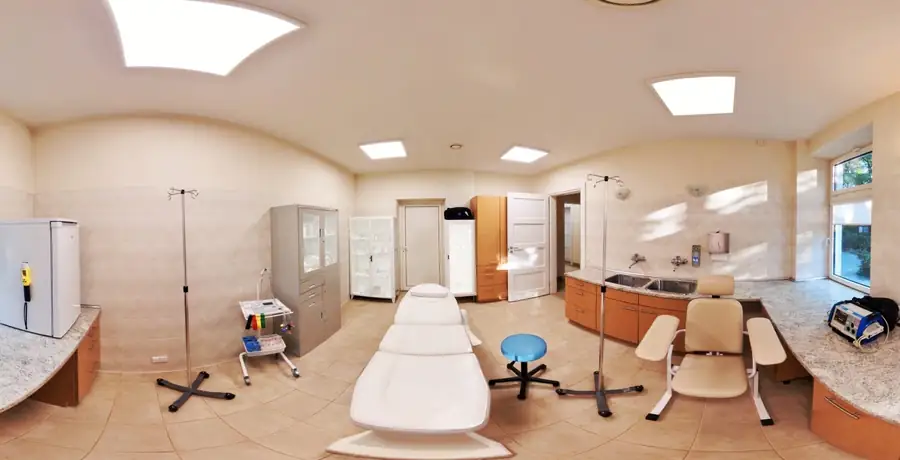





The clinical team works in eleven languages and care is provided in English. We admit patients from Poland and from abroad, with no referral and no waiting list.
We also run drug detox, including controlled withdrawal from benzodiazepines. The team is described on the our team page.

When inpatient alcohol detox is indicated
Detox is indicated
In diagnosed alcohol dependence or where it is suspected. Where earlier attempts to stop alone failed or produced severe symptoms. With physical or psychiatric illness that raises the risk of complications. With medication that interacts with alcohol. Where stabilisation is needed before therapy can start.
Detox is not enough
Where there are no withdrawal symptoms and no clinical indication. Where the expectation is a short intervention with no readiness for further treatment. Where the condition requires an intensive care setting. Where immediate results are expected without further therapeutic work.
Every admission is preceded by an individual clinical assessment. With delirium tremens, acute psychosis or no response to medication, a patient may be transferred to hospital care at a higher level; that decision is taken by the clinical team on the basis of the current assessment. Liver condition is part of that judgement, as set out in how liver condition affects the safety of detoxification.
What the detox programme includes
- medical assessment and risk evaluation before admission
- medical supervision of the detox by the treating doctor
- nurse and paramedic on site around the clock
- monitoring of vital signs and withdrawal symptoms
- laboratory testing and diagnostics where indicated
- hydration and correction of electrolyte balance
- assessment of nutritional state and replacement of deficiencies, including thiamine
- detection of physical illness aggravated by alcohol
- medically justified relief of symptoms
- planning of the next stage of treatment
What alcohol detox will not do
A mismatch of expectations is a common reason why a patient returns to drinking within weeks of detox. A few things are worth knowing in advance.
- it does not treat the dependence; it removes the substance and stabilises the body, and changes nothing about the mechanisms that led to drinking
- it does not compress into one day; the most dangerous window falls on the second and third
- it does not replace therapy or medication supporting abstinence
- it does not reverse damage to the liver, pancreas and nervous system, which needs separate follow-up
- it does not work once and for all; every further withdrawal without supervision is more dangerous than the last
Questions about alcohol detox
How long does it take the body to detox from alcohol?
Alcohol itself clears the blood within hours, but that is not what detox measures. Withdrawal peaks after it has gone: seizure risk between 24 and 48 hours after the last drink, delirium between 48 and 96. A full medical detox therefore runs 3 to 7 nights, and longer after weeks of continuous drinking.
What is the safest way to detox from alcohol?
Under medical assessment rather than by stopping first and seeing what happens. A doctor decides whether the state allows a home detox or whether an inpatient stay is needed. After a short episode a home visit with an infusion is usually enough. After a long period of drinking, with previous seizures, chronic illness or living alone, observation over several days is required.
What are some common symptoms of detox?
Tremor, heavy sweating, anxiety and restlessness, insomnia, nausea, a rapid pulse and rising blood pressure in the first 12 hours. Later, agitation, vomiting, headache and hallucinations with consciousness preserved. In severe cases seizures and delirium tremens, which are medical emergencies.
What are the benefits of quitting alcohol for a few days?
Sleep begins to reorganise, blood pressure and pulse settle, and appetite returns, usually from the third or fourth day. Liver enzymes start falling over weeks rather than days. In someone who is dependent, however, the first few days are also the period of highest medical risk, which is why the benefit only materialises if that window is covered safely.
How much does alcohol detox cost?
Here 3 nights are 2,400 EUR in a double room and 4,800 EUR in a single, and 7 nights 4,800 EUR and 8,400 EUR. A single night is 850 EUR and 1,650 EUR. Full rates are on the pricing page.
Does alcohol detox treat the addiction?
No. Detox is a stage of medical stabilisation and symptom control. Treating the dependence requires alcohol addiction therapy and work on the mechanisms that led to drinking. The gap between detox and therapy is the period of highest relapse risk.
Can I fly here while in withdrawal?
Not during the acute phase. Seizure risk peaks 24 to 48 hours after the last drink, so a flight in that window is a flight without medical cover. Either travel early and be admitted the same day, or stabilise under a local doctor first and come for the therapy stage. We decide which applies during the first call.
Is it safe to stop drinking at home?
For some people alcohol detox at home carries a risk of complications, particularly after long periods of drinking, with previous episodes of severe withdrawal, physical illness or co-occurring psychiatric conditions. A safe decision requires a clinical assessment. An inpatient stay allows observation during the most dangerous window and intervention if it becomes necessary.
Do I have to be sober on the day of admission?
No. Detox concerns the withdrawal period itself, so alcohol being present on arrival does not prevent treatment from starting. How it proceeds is decided by the clinical team after assessing the patient.
Do I need a referral, and how soon can I come?
No referral is needed and admission is usually the same day. It is preceded by a call with the clinical team and an initial assessment of whether inpatient detox is the right level of care.
Can detox require hospital admission?
Yes. With delirium tremens, seizures, acute psychiatric destabilisation or no response to medication, treatment at a higher level of hospital care may be necessary. That decision is taken by the clinical team on the basis of the current assessment.
Is contact confidential?
Yes. Every stage is covered by medical confidentiality. We give no information about a stay to anyone without the patient's written consent, including family and employers.
Alcohol detox is the first stage, not the whole of treatment
Once the patient is stable, the clinical team plans the next stage: therapy, medication supporting abstinence and relapse prevention. Treatment continues in the same centre, without a change of place or team.
Alcohol rehabThe whole process: assessment, detox, therapy, continuing care
02
Alcohol addiction therapyThe stage after detox, working on mechanisms and relapse
03
Alcohol implantDisulfiram as a support, considered once stabilisation is complete
04
Drug detoxMedically supervised withdrawal from other substances
See the centre before you come
The decision is usually made within hours. Four pages worth opening during that call.



More on alcohol withdrawal
- Alcohol withdrawal: when symptoms need urgent clinical assessment
- Is alcohol withdrawal at home safe
- Benzodiazepines and alcohol: risk of serious complications
- How liver condition affects the safety of detoxification
- Alcoholic hepatitis: when urgent evaluation is needed
- Elevated liver tests in a person who drinks
Scope of treatment and clinical responsibility
The information on this page is general and educational. It is not medical advice, a diagnosis or an individual treatment plan. Decisions on suitability for detox, on the level of medical supervision and on further treatment are taken by doctors on the basis of a full clinical assessment.
The course of detox, its length and the interventions used vary with drinking history, physical health, co-existing conditions and the body's response. Stopping alcohol without medical contact can carry a risk of complications. Published prices are list prices and may change; current rates are on the pricing page. The model of care described applies to clinical practice in Poland.
Content author
Content on this site is prepared by the interdisciplinary team at Zeus Detox & Rehab, working with doctors, psychotherapists, clinical psychologists and nursing staff, on the basis of current medical knowledge and experience in inpatient addiction treatment.
 Clinical team
Zeus Detox & Rehab
Clinical team
Zeus Detox & Rehab
Medical review
Review covers medical and pharmacological content and the organisation of clinical supervision. Diagnostic and therapeutic decisions are always taken on the basis of an individual assessment of the patient's health.
 Dr Sławomir Rejowski
Lead doctor, Zeus Detox & Rehab
Dr Sławomir Rejowski
Lead doctor, Zeus Detox & Rehab
Clinical responsibility
Final responsibility for the consistency of this content with current treatment standards and clinical practice rests with the medical director of Zeus Detox & Rehab.
 Andrzej Kulesza
Medical director, Zeus Detox & Rehab
Andrzej Kulesza
Medical director, Zeus Detox & Rehab
Last medical update: 09/2026