



Alcohol addiction therapy
Alcohol addiction therapy is the stage that follows withdrawal, and it deals with the psychological mechanisms that keep drinking in place. We run it as an inpatient programme under medical supervision, at a centre outside Warsaw that admits no more than ten patients at a time. Individual sessions are held in English.
25 minutes from Chopin airport
What alcohol addiction therapy involves
Stopping alcohol removes the substance from the body. Alcohol addiction therapy begins at that point and deals with what led to the drinking, and with what makes a person return to it after a period of abstinence. These are two different things, and neither replaces the other.
Mechanisms of addiction
The patient learns to recognise the situations, emotions and thoughts that precede a drink, and to interrupt that chain earlier than at the point of deciding to drink.
Emotional regulation
For many people alcohol works as a regulator of tension, anxiety and insomnia. Removing it without putting something else in that role ends in relapse.
Relapse prevention
Recognising alcohol craving and early warning signs, and preparing a specific plan for high-risk situations rather than relying on willpower alone.
Co-occurring disorders
Depression, anxiety disorders and sleep disturbance accompany alcohol dependence very often. Left untreated they sustain drinking regardless of motivation. See dual diagnosis treatment.
Alcohol therapy and alcohol detox are not the same stage
Alcohol detox is a medical procedure and deals with physical withdrawal: tremor, raised blood pressure, disturbed sleep, the risk of seizures and delirium. Psychological work starts once acute withdrawal has settled, because it requires working memory, concentration and the ability to hold a conversation.
For patients who drink in binges or daily, we run both stages one after the other in the same building. The gap between finishing detox and starting alcohol addiction therapy is the period of highest relapse risk, so there is no change of place and no change of team between them.
Urgent medical help is needed if withdrawal produces:
- seizures or loss of consciousness
- severe confusion or signs of psychosis
- aggression out of keeping with the situation
- chest pain or difficulty breathing
- high fever with hallucinations
- suspected overdose
In these situations no one should attempt treatment alone or begin therapy. Where life or health is at risk, call emergency services immediately on 112, the emergency number in Poland and across the European Union.
How long is alcohol rehab
Length depends first on the form of treatment and only then on the individual. The ranges below are the ones in general clinical use, so that the options can be compared.
| Form of treatment | How long | Setting |
|---|---|---|
| Inpatient alcohol rehab, core programme | 28 nights | residential, 24 hours a day |
| Inpatient alcohol rehab, extended programme | 6 to 12 weeks | residential, 24 hours a day |
| Day programme | 6 to 8 weeks | several hours a day, sleeping at home |
| Outpatient therapy | several months to 2 years | 1 to 2 sessions a week |
| Online therapy | depends on the plan | remote, without medical supervision |
We run the inpatient form only. The core programme is 28 nights, which is the length most often described as a 28 day rehab. The scope and duration are set after medical assessment, based on how long the dependence has lasted, how many treatment attempts came before, physical health and any co-occurring conditions.
What alcohol addiction therapy looks like day to day
Inpatient alcohol addiction therapy is built on a fixed structure to the day, and the rhythm is itself part of the treatment: it restores sleep, appetite and the ability to plan, all of which are disrupted in people who have been drinking for a long time.
Health check
- blood pressure and vital signs
- review of sleep, appetite and mood
- medication as prescribed by the doctor
- anything outside the expected range reported to the doctor
Therapy session
- individual psychotherapy with an addiction therapist
- work on the task set the previous day
- review of high-risk situations
Own work and consultations
- therapeutic assignments to complete alone
- psychiatric consultation where indicated
- movement or relaxation sessions if recommended
End of day review
- conversation with a therapist or nurse
- entry in the recovery journal
- preparation for the night, sleep quality noted
How many sessions a patient has in a week depends on the language the alcohol addiction therapy is conducted in. We state it plainly, because the question comes up at every assessment and most centres will not answer it before admission.
| Language of therapy | Individual sessions | Group sessions |
|---|---|---|
| English | 6 a week | open to English-speaking patients |
| Polish | 5 a week | 2 a week |
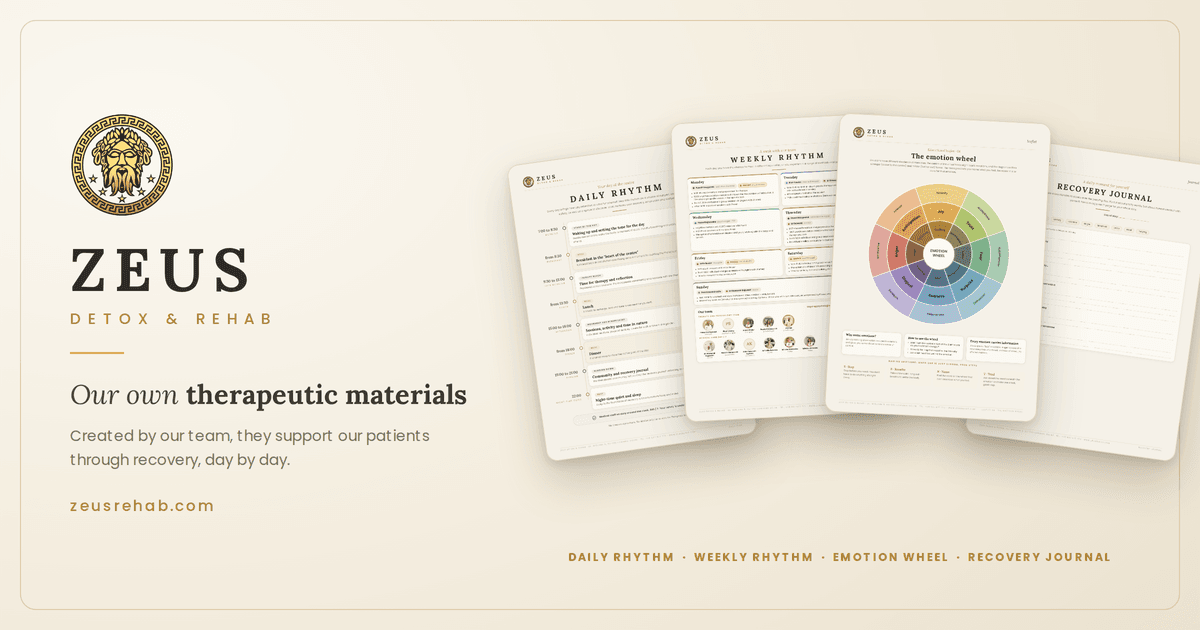
An English-speaking patient has 6 individual sessions a week, which is more one-to-one time than the Polish track, and can also join the group sessions and the Sunday meeting. We give these numbers before admission rather than after arrival, because the amount of individual time is the difference that patients travelling from abroad ask about first. Materials used during the stay are published in the daily and weekly rhythm section.
Therapy for alcohol addiction: the methods used
Psychotherapy is the core of alcohol addiction therapy here. It is delivered by certified addiction therapists, with the treating doctor and a psychiatrist supervising the clinical side.
Cognitive behavioural therapy
Work on the links between situation, thought, emotion and behaviour. The patient maps their own chains leading to a drink and learns to break them earlier. This approach has the widest evidence base in alcohol dependence.
Motivational interviewing
A conversation without confrontation or judgement, aimed at strengthening the patient's own reasons for change. Particularly useful for people who arrive under pressure from family, an employer or a court.
Work on the mechanisms of addiction
Recognising denial, the illusion of control over drinking, and the beliefs that sustain it. This part decides whether a patient later recognises relapse at the stage of thinking about it rather than after a drink.
Psychiatric supervision and medication
Patients remain under psychiatric supervision throughout the stay. Medication supporting abstinence and treatment of co-occurring disorders are selected individually and monitored.
Alcohol craving and relapse prevention
Alcohol craving is a sudden, strong urge to drink that appears months, and for some people years, after stopping, and it does not answer to willpower. It is set off by specific cues: a place, a smell, a time of day, an argument, exhaustion, and in some patients by positive emotions such as celebrating or relief.
Alcohol addiction therapy teaches three things in this order: recognise alcohol craving before it builds, sit through it without acting, and have a prepared response for the times when sitting through it is not enough. Patients leave with a written plan for high-risk situations, a list of warning signs and agreed contacts to call.
How the programme runs, step by step
The programme has four separate stages. Keeping them separate matters, because the order determines the result: psychological work started too early achieves nothing, and prolonged stabilisation without therapeutic work ends in relapse after discharge.
| Stage | When | What happens |
|---|---|---|
| 1. Assessment | before admission | A call, an assessment of how severe the dependence is, the history of earlier attempts, co-existing illness and current medication. This determines whether detox is needed first. |
| 2. Stabilisation | first days of the stay | Tests, correction of deficiencies, sleep regulation, treatment of withdrawal symptoms. Sessions in this period are short and oriented to orientation rather than depth. |
| 3. Therapeutic work | the core of the programme | Individual sessions, work on the mechanisms of addiction, on emotions and on relapse. Psychiatric consultations where indicated. |
| 4. Exit plan | final week | A written plan for high-risk situations, a list of warning signs, recommendations for outpatient therapy and medication, agreed contacts. |
Inpatient alcohol rehab outside Warsaw
The centre is at ul. Wiślana 5 in Łomianki Dolne, 10 km from central Warsaw and 25 minutes from Chopin airport. We admit patients from Poland and from abroad. There are no branches in other cities, but an inpatient stay does not require living nearby: the patient comes for the whole programme.






The clinical team works in eleven languages, and individual therapy sessions are held in English. Patients stay in rooms from triple up to apartments, with the option of individual inpatient care.
Where medical intervention is needed at home before admission, alcohol detox at home in Warsaw is available with a doctor visiting. The team is described on the our team page.

Alcohol rehab cost and how to get here
What alcohol rehab costs here
The 28 night programme is 9 900 EUR in a double room and 19 900 EUR in a single room, which is 11 500 and 23 100 USD. Other standards, and rates in other currencies, are on the pricing page.
What the price covers
Accommodation, medical supervision, round-the-clock nursing and paramedic cover, psychiatric consultations, psychotherapy sessions and meals. Detox beforehand, where it is needed, is billed separately.
Coming from abroad
Warsaw has direct flights from most European capitals and the centre is 25 minutes from Chopin airport. No referral is needed and there is no waiting list; admission is usually within a few days of the first call.
Online alcohol therapy
We provide it as a continuation only, for patients who have completed the full inpatient programme. Remote sessions sustain the work started here. They do not replace medical supervision during withdrawal and are not a starting point for someone beginning treatment.
When inpatient alcohol addiction therapy is the right step
When alcohol addiction therapy is indicated
In diagnosed alcohol dependence. After medical stabilisation, when further work is needed. After relapse despite earlier treatment. With co-occurring depression or anxiety disorders. Where drinking threatens work, family or physical health. Where outpatient treatment has not been enough.
When alcohol addiction therapy is not enough on its own
During acute withdrawal, before medical stabilisation. In emergencies requiring hospital admission. Where there is no readiness to take part in a conversation. As a one-off measure with no plan for continuing care. With acute psychotic symptoms requiring a psychiatric ward.
Every admission is preceded by an individual clinical assessment, and the decision rests with the treating doctor.
How to help someone with alcohol addiction
More often than not it is a family member who calls, not the patient. Three things matter at that point: do not negotiate the terms of treatment while the person is drinking, do not announce consequences you do not intend to apply, and fix a date and a place in advance so the decision does not depend on the mood of the day.
What the programme includes
- clinical assessment and severity rating before admission
- an individual treatment plan, reviewed during the stay
- individual psychotherapy with a certified addiction therapist
- medical supervision of the treatment by the treating doctor
- nurse and paramedic on site around the clock
- psychiatric consultations and treatment of co-occurring disorders
- medication supporting abstinence where indicated
- work on alcohol craving and recognising relapse
- laboratory testing and assessment of physical complications
- a continuing care plan and recommendations for after discharge
What treatment will not do for the patient
A mismatch of expectations is one of the more common reasons people break off treatment in the first week. A few things are worth knowing in advance.
- it does not remove the dependence permanently; it produces remission and the tools to hold it, not a return to controlled drinking
- it does not work without the patient; there is no procedure that can be carried out on a passive person
- it does not repair family relationships on its own; rebuilding trust takes longer than the stay
- it does not cancel legal or professional consequences
- it does not replace treatment of physical illness, which needs separate follow-up after discharge
Questions about alcohol addiction therapy
What therapy is used for alcoholism?
Most commonly cognitive behavioural therapy, motivational interviewing and structured work on the mechanisms of addiction, combined with relapse prevention. In an inpatient setting these are delivered alongside medical and psychiatric supervision, and where indicated alongside medication supporting abstinence.
How to overcome alcohol addiction?
Through a combination rather than a single measure: safe withdrawal under medical supervision, psychotherapy over a defined period, treatment of co-occurring disorders, medication supporting abstinence where indicated, and a plan for continuing care once the intensive stage ends. A single step, such as an implant on its own or detox on its own, produces a short-lived effect.
Which approach works for someone dependent on alcohol?
There is no single form suited to everyone. It depends on the severity of the dependence, the history of earlier attempts, physical health and any psychiatric conditions. Years of dependence, previous relapses or co-occurring depression usually call for an inpatient setting. A shorter drinking history with a stable home situation is often served by outpatient therapy. The choice should follow a medical assessment rather than preference alone.
What are the different stages of alcoholism?
Clinically the course runs from risky drinking, through harmful use, to dependence, in which tolerance rises, control over the amount is lost and withdrawal symptoms appear on stopping. The stages are not sharply divided and a person can move between them over years. What decides the form of treatment is the current clinical picture, not the label.
How long is alcohol rehab?
Our inpatient core programme is 28 nights, with an extended version of 6 to 12 weeks. Day programmes usually run 6 to 8 weeks and outpatient therapy from several months to two years. The exact length is set after medical assessment.
How much does alcohol rehab cost here?
The 28 night programme is 9 900 EUR in a double room and 19 900 EUR in a single room, or 11 500 and 23 100 USD. Detox beforehand, where needed, is billed separately. Full rates are on the pricing page.
How many alcohol therapy sessions a week will I have?
6 individual sessions a week in English. Group sessions and the Sunday meeting are open to you as well. Patients working in Polish have 5 individual sessions and 2 group sessions a week, so an English-speaking patient gets more one-to-one time.
Are the sessions in English?
Individual psychotherapy, the medical assessment and all contact with the clinical team are in English, and there are 6 individual sessions a week. Group sessions and the Sunday meeting are open to English-speaking patients too. The clinical team works in eleven languages.
How does alcohol addiction therapy differ from detox?
Detox deals with physical withdrawal and is a medical procedure lasting from a few days to about two weeks. Therapeutic work begins once acute symptoms settle and deals with psychological mechanisms. Detox without therapy does not treat the dependence, and therapy started before medical stabilisation is not safe.
Does alcohol craving come back after therapy?
Alcohol craving can appear months, and for some people years, after stopping, and on its own it does not mean relapse. The programme teaches how to recognise it early and how to have a prepared response, rather than relying on willpower.
Do I need a referral, and is there a waiting list?
No referral is needed and there is no waiting list. Admission follows a clinical call and an initial assessment of whether inpatient care is the right level. In practice this is usually a few days.
Is treatment confidential?
Yes. Every stage is covered by medical confidentiality. We give no information about a stay to anyone without the patient's written consent, including family and employers.
Alcohol addiction therapy does not end when the stay does
Inpatient alcohol addiction therapy is a stage, not the whole of treatment. The team prepares individual recommendations for outpatient therapy, group support, medication and relapse prevention.
Alcohol rehabThe whole process: assessment, stabilisation, therapy, continuing care
02
Alcohol detoxThe stage before therapy, where it is clinically indicated
03
Alcohol implantDisulfiram as a support alongside therapy, never instead of it
04
Dual diagnosisAddiction with a co-occurring psychiatric disorder
See the centre before you travel
Deciding on several weeks away is easier once you know what the place looks like, who delivers the treatment and what it costs. Four pages worth starting with.



Scope of treatment and clinical responsibility
The information on this page is general and educational. It is not medical advice, a diagnosis or an individual treatment plan. Decisions on suitability, on the level of medical supervision and on further treatment are taken by doctors on the basis of a full clinical assessment.
The course, length and scope of alcohol addiction therapy vary with drinking history, physical health, co-existing conditions and the response to treatment. Supporting interventions play a complementary role, do not replace medical or psychotherapeutic treatment, and do not determine clinical outcomes. Published prices are list prices and may change; current rates are on the pricing page. The model of care described applies to clinical practice in Poland.
Content author
Content on this site is prepared by the interdisciplinary team at Zeus Detox & Rehab, working with doctors, psychotherapists, clinical psychologists and nursing staff, on the basis of current medical knowledge and experience in inpatient addiction treatment.
 Clinical team
Zeus Detox & Rehab
Clinical team
Zeus Detox & Rehab
Medical review
Review covers medical and pharmacological content and the organisation of clinical supervision. Diagnostic and therapeutic decisions are always taken on the basis of an individual assessment of the patient's health.
 Dr Sławomir Rejowski
Lead doctor, Zeus Detox & Rehab
Dr Sławomir Rejowski
Lead doctor, Zeus Detox & Rehab
Clinical responsibility
Final responsibility for the consistency of this content with current treatment standards and clinical practice rests with the medical director of Zeus Detox & Rehab.
 Andrzej Kulesza
Medical director, Zeus Detox & Rehab
Andrzej Kulesza
Medical director, Zeus Detox & Rehab
Last medical update: 09/2026