



Alcohol Implant (Disulfiram)
An alcohol implant is a disulfiram depot placed under the skin. It does not reduce craving and it does not treat addiction. What it does is make drinking physically unpleasant enough that the decision stops being available on impulse, for a defined period. We place implants at our inpatient centre near Warsaw, in English, for patients travelling from the United Kingdom, Ireland, the United States and elsewhere.
What an alcohol implant is
Disulfiram blocks aldehyde dehydrogenase, the enzyme that clears acetaldehyde, the first breakdown product of alcohol. With the enzyme blocked, acetaldehyde accumulates instead of being processed, and the result is flushing, pounding headache, nausea, vomiting, a racing heart and a drop in blood pressure.
The implant is a set of tablets placed under the skin, usually in the lower abdominal wall, through a small incision. It is the same substance as the oral form. The difference is that once it is in, taking it is no longer a daily decision.
Other names for the same treatment
This procedure carries a different name in almost every country, which makes searching for it unusually confusing.
| What people call it | What it refers to |
|---|---|
| Esperal implant | The brand name used in Poland and France. The same disulfiram |
| Antabuse implant | Antabuse is the brand familiar in the UK and the US, usually as the oral tablet |
| Disulfiram implant, disulfiram pellet | The clinical terms for what is actually placed |
| Anti alcohol implant, implant to stop alcohol | Descriptive terms patients use. Same procedure |
| Alcohol implant | Common in the UK. Worth noting that most search results for this phrase concern drinking after dental implants, which is a different subject entirely |
How the deterrent works
Naltrexone removes the reward from drinking. Disulfiram does the opposite: it attaches a consequence to it. Nothing happens while a patient stays away from alcohol. The implant is silent until it is tested, and then it is not.
This is why disulfiram suits a particular kind of patient and not others. It does nothing for craving. A person who wants to drink will still want to drink. What changes is that acting on the urge now carries a cost that is immediate, physical and not negotiable in the moment.
What the evidence actually shows
We will be direct about this, because patients travelling from abroad tend to read the literature and should hear it from us first rather than find it afterwards.
Disulfiram as a drug is well established. Where it is taken under supervision, it performs better than most alcohol pharmacotherapy. The debate is not about the substance. It is about the implant.
The reference trial is Johnsen and Morland, 1991, a double blind study of 76 patients comparing an active disulfiram implant against a placebo implant. It found no significant difference between the groups in reduction of drinking, in time to the first drink, or in psychosocial function. Both groups improved, which the authors attributed to the deterrent effect of believing an implant is in place. The active implant produced more wound complications.
Read honestly, that means an implant is best understood as a fixed, time limited commitment rather than a pharmacological barrier that can be relied on. It is a decision made once, in front of a doctor, which then stands for months without having to be made again each morning. For some patients that structure is precisely what was missing. For others it is not enough, and we say so at qualification rather than after payment.
None of that changes one rule.
Do not test it. A disulfiram reaction can be severe and occasionally dangerous, and no patient can know in advance how much active substance they are carrying. The discussion above concerns average effects across a study group. It says nothing about what would happen to you.
Does an alcohol implant treat alcoholism
No, and it should not be presented that way by anyone.
- It does not remove psychological dependence.
- It does not reduce craving.
- It does not change how a person copes with stress.
- It does not treat trauma or any co-occurring mental health condition.
Its role is limited to supporting abstinence for a period, through deterrence. Lasting recovery needs psychotherapy, psychiatric care where indicated, and a relapse prevention plan. The implant is an addition to alcohol addiction treatment, never a substitute for it.
Sobriety required before placement
Disulfiram cannot be given to someone with alcohol still in their system. Doing so triggers the reaction immediately, while the patient is on the table.
Conditions that must be met before placement.
- At least 24 hours without alcohol. After a prolonged binge a longer interval is required and is set by the doctor, not by the calendar.
- No active withdrawal. Tremor, sweating, agitation or hallucinations mean detoxification comes first, not an implant.
- Liver function assessed, since disulfiram is hepatically metabolised and liver damage is common after years of drinking.
- A review of current medication, in particular metronidazole and anything containing alcohol.
If withdrawal is under way, the correct first step is medically supervised alcohol detox.
What the procedure involves
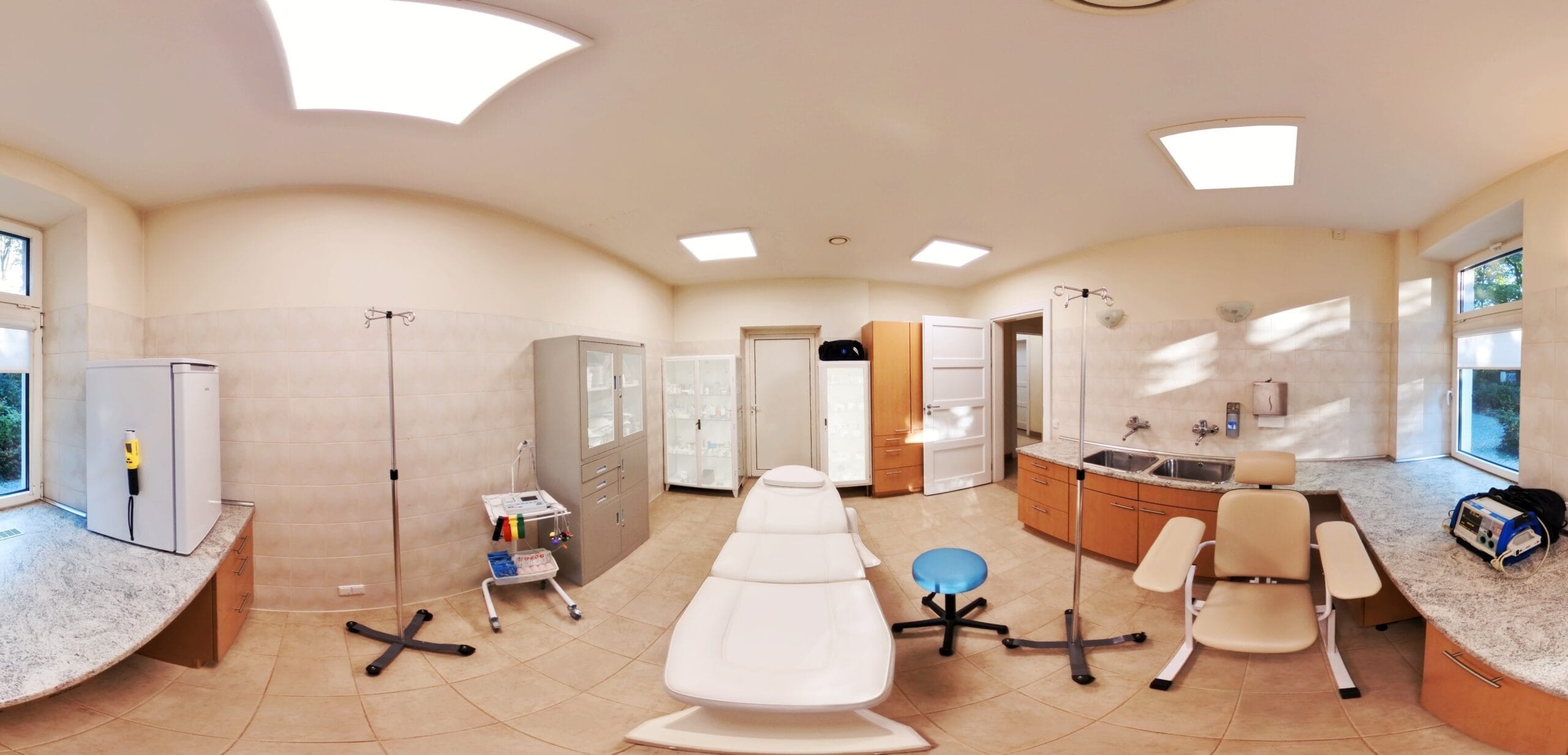
Qualification and placement can normally take place on the same day, provided the sobriety requirement has been met. The procedure takes 20 to 30 minutes under local anaesthetic.
The tablets are placed subcutaneously through a small incision, which is then closed. Patients leave with written aftercare instructions covering wound care, what to avoid, and what to tell any doctor who treats them during the months that follow.
Alcohol implant cost
Price
1,250 PLN. At current central bank rates that is roughly 340 USD, 290 EUR or 250 GBP. The charge is made in Polish zloty, so the alcohol implant cost in your currency depends on the rate on the day.
What it includes
Medical qualification, the procedure, the implant, and written aftercare instructions.
What it does not include
Detoxification, inpatient stay and therapy are separate elements of treatment and are priced separately.
Travel
Flights, transfers and any stay beyond the procedure are arranged and paid for by the patient unless agreed otherwise in advance.
Patients travelling from abroad
Enquiries reach us from the United Kingdom, Ireland, the United States, South Africa and Australia. Oral disulfiram is licensed and available in most of those countries under the name Antabuse. Alcohol implant treatment is a different matter, and availability varies considerably, which is usually what prompts someone to look beyond their own system.
Practically, travelling here means four things. You must arrive sober, and that is not negotiable, so plan the journey accordingly. Qualification and placement can normally happen on the same day. Assessment, procedure and aftercare instructions are in English. The price is fixed in Polish zloty and quoted before you travel.
What you must avoid while the implant is in place
The reaction does not require a drink. It requires alcohol, and alcohol turns up in places patients do not expect.
| Source | Examples |
|---|---|
| Medicines | Cough syrups, tonics and tinctures, some oral liquids. Metronidazole must be avoided separately, as it interacts with disulfiram directly |
| Food | Sauces, desserts and dishes finished with wine or spirits, some vinegars |
| Applied to skin | Aftershave, alcohol based hand gel and some cosmetics, in sensitive patients |
| Non alcoholic drinks | Products labelled alcohol free may still contain small residual amounts |
Every patient leaves with this list in writing. It matters more than it sounds, because most unexpected reactions come from the first two rows rather than from a deliberate drink.
Who it may be considered for, and who not
May be considered
Patients who have decided to stop, are past withdrawal, and whose relapses are impulsive rather than planned.
Also considered
Patients who want an external commitment for a defined period while therapy gets under way.
Not suitable
Anyone still drinking or in withdrawal, anyone with significant heart disease, severe liver failure, psychosis, or who is pregnant.
Requires caution
Patients with diabetes, epilepsy, kidney disease or a history of severe depression, and anyone unable to understand what the implant does.
Possible complications
Local effects are the most common: pain, swelling, bruising or redness at the site, occasionally infection or extrusion of a tablet. These usually settle within days, though infection needs treatment.
Systemic effects reported with disulfiram include a metallic taste, fatigue, headache and low mood. Rarely, disulfiram is associated with hepatotoxicity and with neurological effects, which is why liver function is assessed beforehand and any jaundice, dark urine or upper right abdominal pain requires medical attention.
Alcohol implant and naltrexone implant, two different methods
| Disulfiram | Naltrexone | |
|---|---|---|
| Principle | Creates an unpleasant reaction after alcohol | Removes the reward from drinking or using |
| If the patient drinks | A physical reaction that can be severe | Nothing dramatic. The effect is simply muted |
| Effect on craving | None | Reduced in many patients |
| Range | Alcohol only | Alcohol and opioids |
| Suits | Someone who wants an external barrier | Someone who wants the pull itself reduced |
Patients who need the second mechanism rather than the first should read about the naltrexone implant, which is a separate procedure with a different price and a different set of conditions.
Disulfiram within a full treatment plan
An implant changes what happens if someone drinks. It changes nothing about why they drink. The patients who do well with it use the months it buys to build something: therapy, structure, and a plan for the point at which the deterrent runs out.
That is why we place implants inside a treatment pathway rather than as a standalone transaction, and why the qualification conversation covers what happens at month twelve. Where a longer programme is appropriate, see alcohol addiction therapy.

When urgent medical help is needed
Seek immediate medical attention in the following situations.
- A disulfiram reaction after drinking, particularly with chest pain, breathlessness, fainting or a severe drop in blood pressure. This is an emergency, not something to wait out.
- Spreading redness, heat, discharge or fever around the implant site.
- Jaundice, dark urine or pain in the upper right abdomen.
- Confusion, seizures or hallucinations, which point to withdrawal rather than to the implant and need urgent assessment.
In a life threatening emergency in Poland call 112.
Johnsen J, Morland J. Disulfiram implant: a double-blind placebo controlled follow-up on treatment outcome. Alcoholism: Clinical and Experimental Research, 1991.
Brewer C, Streel E, Skinner M. Supervised Disulfiram's Superior Effectiveness in Alcoholism Treatment. Alcohol and Alcoholism, 2017.
Disulfiram Implantation Critically Evaluated. British Journal of Psychiatry.
Disulfiram efficacy in the treatment of alcohol dependence: a meta-analysis, 2014.
Beyond the implant

Alcohol Addiction TreatmentThe full inpatient programme the implant belongs to
02
Alcohol DetoxThe step that comes first if withdrawal is under way
03
Alcohol Addiction TherapyThe work that decides what happens after month twelve
04
Naltrexone ImplantThe opposite mechanism, for patients who need craving reduced


